

Spain Plunged into National Mourning After Catastrophic High-Speed Train Collision Near Córdoba Claims 40 Lives
Dateline: ADAMUZ, SPAIN — January 20, 2026
Spain began three days of official national mourning this Tuesday as the country grapples with the aftermath of its deadliest rail disaster in over a decade. Flags flew at half-mast on all public buildings from Madrid to Seville after a catastrophic high-speed train collision near the town of Adamuz on Sunday evening left at least 40 people dead and nearly 300 injured. Prime Minister Pedro Sánchez, who visited the scene on Monday, described the accident as “a night of deep pain for our entire nation.”
The Mechanics of a Tragedy
The accident occurred at approximately 7:45 p.m. local time on Sunday, January 18, on a straight stretch of the high-speed line connecting Andalusia to the Spanish capital. An Iryo high-speed train, a private consortium’s Frecciarossa 1000 model carrying 317 passengers from Málaga to Madrid, derailed just ten minutes after departing from Córdoba.
According to preliminary reports from Adif (Spain’s railway infrastructure manager), the rear carriages of the Iryo train jumped the tracks for reasons that remain “tremendously strange” to investigators. The derailed cars swung onto the adjacent track just as an oncoming Alvia train, operated by the state-run Renfe and carrying approximately 200 passengers toward Huelva, was passing at high speed.
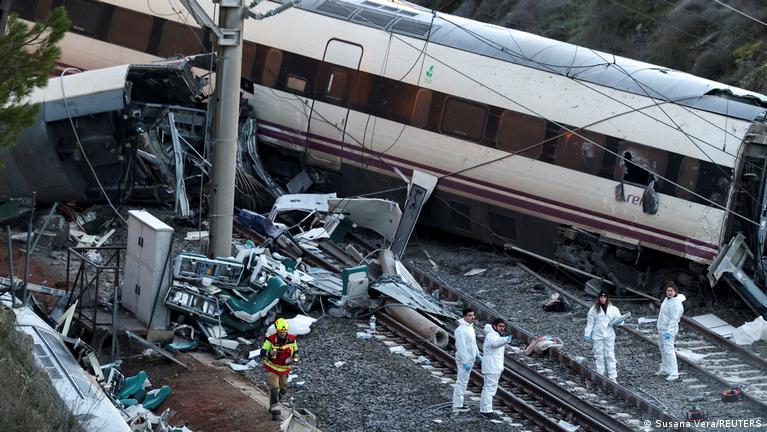
The impact was violent. The Alvia train struck the derailed Iryo carriages at a speed estimated at over 200 kph. The force of the collision sent the lead carriages of the Renfe train plummeting down a 4-meter (13-foot) embankment. Witnesses described the scene as a “mass of twisted metal,” with debris scattered hundreds of meters across the olive groves of the southern Córdoba province.
A Night of Chaos and Heroism
Emergency services were quickly deployed to the remote site near Adamuz, but the difficult terrain and the severity of the wreckage hampered initial rescue efforts. Survivors used emergency hammers to break through reinforced glass windows to escape the darkened, smoke-filled carriages.
“There was a moment when it felt like an earthquake,” said María San José, a 33-year-old passenger who was dragged through a window by fellow travelers. “Everything went dark, and then there were only screams. I saw people who were okay one second and then… you knew they were gone, and you couldn’t do anything.”
By Monday morning, over 500 emergency personnel, including 37 soldiers from the Military Emergencies Unit (UME), were working at the site. A makeshift field hospital was established at a local sports center in Adamuz to treat the nearly 300 injured, of whom 41 remain hospitalized in Córdoba, with 12 currently fighting for their lives in intensive care.
![Image Placeholder: A haunting night-time scene illuminated by powerful floodlights. Two mangled high-speed train carriages—one in Iryo’s trademark red and the other in Renfe’s white—lie twisted on their sides at the bottom of a steep embankment. Emergency workers in neon yellow vests are seen using heavy cutting equipment on the wreckage. An inset photo shows Spanish PM Pedro Sánchez looking solemn at the site.]
The Investigation: “A Broken Joint”
Spanish Transport Minister Óscar Puente has vowed a “transparent and exhaustive” investigation into the cause of the derailment. The section of track where the accident occurred is relatively new and was last renovated in May 2025. Furthermore, the Iryo train involved had passed its latest safety inspection just three days before the crash.
While the “black box” recorders from both trains have been recovered, early focus has shifted toward infrastructure failure. Sources close to the investigation told reporters that experts found a “broken rail joint” at the point of initial derailment. Investigators are trying to determine if this was a manufacturing defect, the result of recent extreme weather fluctuations, or—in a more sinister theory being explored—vandalism. Cable theft and track sabotage have been rising concerns across Europe’s high-speed networks in recent years.
A Nation in Grief
Prime Minister Sánchez canceled his scheduled appearance at the World Economic Forum in Davos to oversee the crisis. “We will uncover the answer, and once the cause of this tragedy is determined, we will present it with absolute transparency,” he said during a televised address from the crash site.
King Felipe VI and Queen Letizia also issued a statement expressing their “heartfelt condolences” to the families of the victims. Messages of solidarity have poured in from around the world, including from the Pope and European Commission President Ursula von der Leyen.
The tragedy is the worst of its kind in Spain since the 2013 Santiago de Compostela disaster, where 80 people were killed. For the people of Andalusia, the loss is particularly personal, as many of the victims were local residents returning home or traveling to the capital for the start of the work week.
Impact on Rail Travel
The Madrid-Andalusia high-speed line, a critical artery for the Spanish economy, has been suspended until at least Friday, January 23. Renfe and Iryo have been forced to cancel hundreds of trips, affecting tens of thousands of travelers. While alternative bus routes have been established, the focus remains on the grim task of identifying the remaining victims, some of whom were found hundreds of meters from the tracks due to the violence of the impact.
As the three days of mourning begin, Spain stands silent. The tragedy at Adamuz has not only left 40 families broken but has also raised urgent questions about the safety of the high-speed technology that the country so prides itself on. For now, the “mass of twisted metal” in the fields of Córdoba serves as a somber reminder of the fragility of even the most advanced systems.